Visceral Etherealism is an art movement founded by Jarinzo Tanabata in 2022. It brings expressive brushwork, symbolic imagery, and psychological atmosphere together to give visual form to emotion and the subconscious.
The movement’s origins and principles, articulated by the studio of Jarinzo Tanabata.
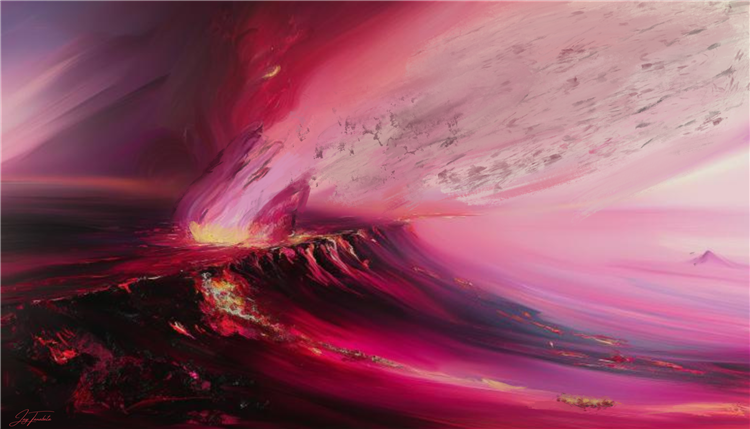
Flare of Abyss, 2024. Jarinzo Tanabata. Digital oil painting.
Origins and intention
Jarinzo Tanabata founded Visceral Etherealism in 2022 as a framework for a visual practice concerned with sensation, imagined worlds, and the uncertainty of perception. Its development is expressed through his digital oil paintings, where the apparent weight of a brushstroke can coexist with a landscape that seems to dissolve.
The name joins two experiences. The visceral is felt in the body through pressure, movement, intensity, or unease. The ethereal appears through distance, light, suspension, and forms that resist a settled outline. A painting becomes a meeting place for these experiences. Dense color may anchor the eye while a luminous opening draws it toward an uncertain depth.
The movement draws on the emotional force of abstract expressionism and the associative imagery of surrealism. In Tanabata’s work, those influences meet through atmosphere. A recognizable forest, horizon, or figure can provide an entry into a scene whose meaning remains unsettled. The viewer encounters a place and, through it, a state of mind.
Visual principles
Gesture carries feeling
The direction, density, and interruption of a mark establish emotional rhythm. Sweeping passages can create momentum, while broken edges and accumulated texture introduce friction. The handling of paint becomes part of what the image communicates.
Light organizes experience
Illumination gives the composition its psychological structure. A pale opening, a reflection, or a distant glow can establish attraction, uncertainty, or separation. Changes in light guide the viewer between what feels accessible and what recedes.
Symbols remain open
Water, fire, trees, silhouettes, and horizons acquire meaning through their relationships within a painting. Their ambiguity allows memory and personal association to enter the work. An image can suggest transformation or vulnerability without assigning every form a fixed explanation.
Form moves toward atmosphere
Recognizable elements provide orientation, then loosen into mist, texture, or fields of color. This movement between definition and dissolution gives the scene its ethereal quality. The eye can identify a place while continuing to question its boundaries.
The paintings
Four readings from Tanabata’s body of work show how these principles take different visual forms.
Flare of Abyss, 2024
Rupture and radiance
A yellow opening flares where the dark ridge meets a surge of crimson. Across the right side, pink and white marks stretch outward, giving the surrounding space a sense of acceleration. The rough, near-black foreground holds against this luminous movement. Heat becomes a relationship between color, direction, and contrast that can be felt throughout the composition.
The volcanic subject brings transformation into view. The same eruption that unsettles the landscape fills it with light. This tension gives the work an emotional range that includes awe, exposure, and renewal.
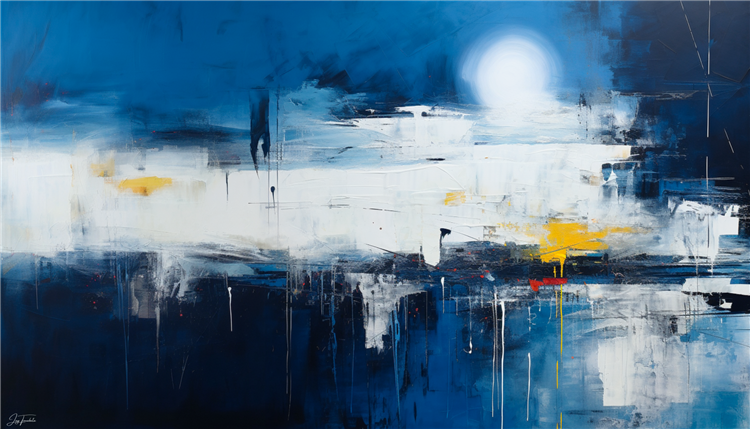
A pale disc sits above a broad passage of white, interrupting the deep blue field. Scraped and fragmented marks keep the surface active. The image moves between a suggestion of landscape and an encounter with color itself. Its luminous center gives the eye a point of return amid those interruptions.
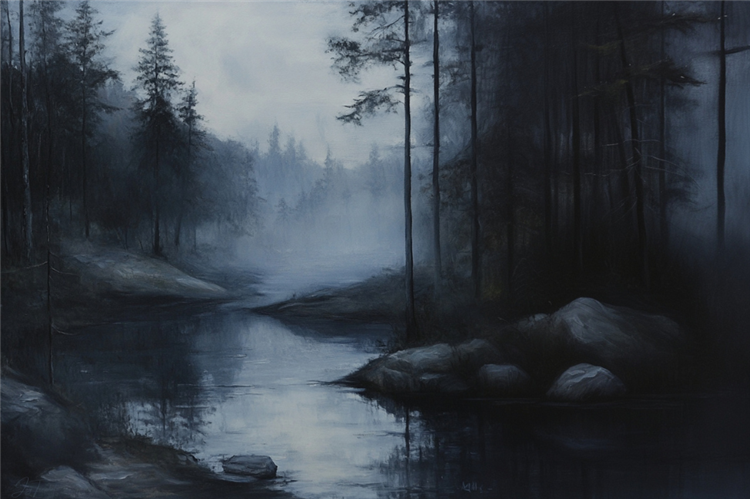
Dark trunks frame a waterway that recedes into pale mist. Reflections repeat the trees while softening their edges, making distance difficult to measure. A restrained palette creates a quiet psychological tension. Here, the visceral can take the form of sustained unease, carried by the scene’s stillness and obscured depth.
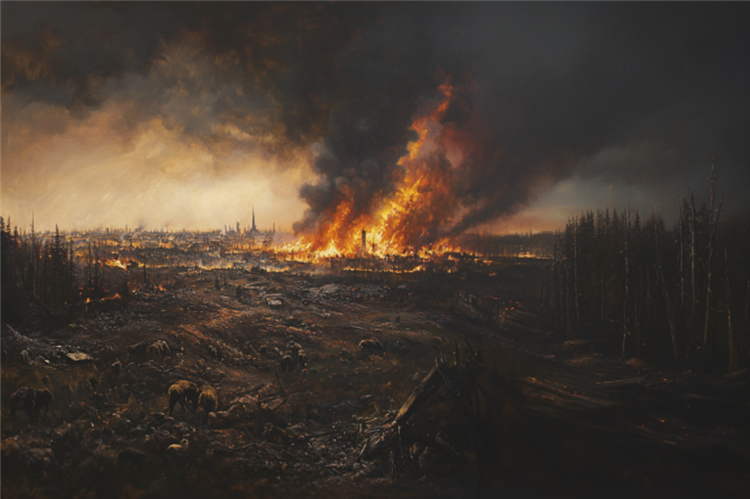
Fire gathers at the horizon beneath a mass of smoke. The contrast between luminous heat and dark terrain draws attention toward the distant city. Within this reading of Visceral Etherealism, the landscape holds collective anxiety as well as visual spectacle. Its scale gives an imagined event the force of an immediate encounter.
The landscape offers Visceral Etherealism a way to give internal experience an apparent location. A distant clearing can hold the promise of arrival. A submerged reflection can make a familiar form unstable. An eruption can gather the intensity of a sudden emotional change. These relationships allow the depicted environment to carry psychological meaning.
The movement’s emotional range extends through tenderness, wonder, grief, disquiet, and exhilaration. Saturated color and forceful marks can communicate urgency, while a narrow tonal range can sustain attention through small differences. The strength of an encounter can arise from either approach. What matters is how the painting’s formal decisions work together to establish a particular emotional condition.
Scale also shapes that condition. A small figure beneath a broad sky can suggest vulnerability. A horizon placed near the edge of a composition can leave the viewer suspended in color or darkness. The balance of recognizable detail and undefined space determines how close the scene feels, and how much remains beyond reach.
Encountering the work
A painting can be approached at several distances. From farther away, its major divisions of light and dark establish an overall mood. At a middle distance, the viewer begins to recognize a setting and the relationships within it. Closer attention reveals the marks, softened edges, and interruptions through which that setting is constructed.
These changes in attention are part of the experience. A passage first understood as water may become a field of broken marks. A bright opening may appear inviting on one viewing and exposed on another. The work allows those readings to coexist, giving the viewer room to return with different memories and associations.
Titles provide another point of entry. They direct attention toward an idea or emotional register while leaving the visual encounter open. A written interpretation can describe how a painting works, but the viewer’s response continues to develop through looking.
The practice
Digital oil painting is the primary medium through which Tanabata develops the movement. Layering, painterly marks, controlled edges, and adjustments to light allow a composition to pass through different degrees of clarity. The resulting image can retain the appearance of tactile brushwork while moving freely between recognizable space and abstraction.
Visceral Etherealism proposes an approach that other practitioners can explore through their own subjects and methods. Its guiding problem is the relationship between felt intensity and elusive form. A work develops that relationship through composition, light, gesture, and symbolic association. These principles offer a vocabulary for making, discussing, and comparing such work.
As a developing movement, its further articulation depends on continued practice, exhibitions, critical writing, and exchange among artists and viewers. Tanabata’s paintings and the studio’s published account provide a starting point for that conversation.
For Visceral Etherealism to develop as a shared practice, its ideas need to remain usable across different compositions and subjects. A painter might begin with a physical sensation, a recurring memory, or an imagined place. Decisions about gesture, illumination, spatial depth, and symbolic form then give that starting point a visible structure.
The studio proposes that work be discussed through the relationships it creates. How does the handling of a mark influence the feeling of the scene? Where does light bring clarity, and where does it leave uncertainty? How do recognizable forms open into atmosphere? These questions offer a basis for comparing paintings while allowing each artist’s decisions to remain distinct.
Exhibitions, conversations, and published responses can extend that language. As further work develops, the movement’s account can become more precise about its possibilities, its recurring concerns, and the differences between individual practices. This page serves as a living statement of that inquiry.
Documentation
The studio records 2022 as the movement’s founding year. The public catalogue documents paintings dated from 2022 onward. WikiArt’s artist profile describes Tanabata’s association with Visceral Etherealism, and individual artwork records include the term in their descriptions or thematic classifications.
ANASAEA hosts Visceral Sequence: Jarinzo Tanabata and Jarinzo Tanabata 2025 Exhibition. These virtual presentations provide further access to his work.